See photos of selected works under the cut.
Sunday, May 24, 2015
Creative Mischief at the National Academy Museum
See photos of selected works under the cut.
Wednesday, May 6, 2015
Violentango at Argentinian Consulate
![]() |
| Violentango at the Argentinian Consulate, 5.5.15 |
On Monday
night, at Valeria
Solomonoff's consistently enjoyable Tango Playground Practica, I exhorted
my partners to be present without ambivalence, misbehave and “milk it” -
"it" being all the particularly delectable morsels of music and movement.
I noticed that those born north of about 25-30° north latitude are often
inhibited when it comes to this to-do list, and I myself, hailing all the way
from 60° N, am no exception.
No such exhortations were needed on Tuesday evening at
the Argentinian Consulate, where Violentango
played a free concert. Whether or not their music has much to do with violence
or with tango (although, at least according to Borges, tango has always something to do with fighting), these guys know how to go for it with a
vengeance and not just play music, but play with
the music of two generations before them – their grandfathers’ tango and rock
music of their parents, plus a gamut of other voices and influences, – and make
it all sound intriguing and contemporary. A little over a week ago, Astoria
Tango Orchestra performed with Daniel
Binelli, – and it was great to hear and dance to the traditional sound of orquesta
tipica. The music of Violenango is not for keeping milongueros on their feet,
but it is also traditional in the sense that it is made of the same ingredients:
talent, skill, and inspiration of the players, with nothing canned or
boxed other than some juice to amplify the sound of their instruments – two guitars, bandoneon, electric bass and percussion.
‘Tis a season for conversions in my artistic tastes: never
a big fan of new tango music, I went to the Consulate with a pragmatic purpose –
to scout out the space for a future event, – and was pleasantly surprised to discover
Violentango and their unadorned sound. They played their own compositions as
well as a couple of pieces by Piazzolla and a few oldies but goodies, such as
Milonga de mis amores, which lends itself well to instrumental inventiveness
and embellishment. Musically, these guys know how to misbehave and milk it for
what it’s worth, with improvisation, ingenious sounds and quotes from a variety
of styles, from jazz to folkloric, thrown in with cleverness, virtuosity and
humor. It occurred to me that, unlike traditional tango, this music has the momentum
to go somewhere, as it allows itself to be discontented and seek a way to
escape its own status quo or upset it, out of its own abundance, boredom, mischief,
or subversion – or just for the heck of it.
There are plenty of Violentango videos and recordings
online, but they do not give you a sense of energy that these guys whip up
while playing live. It is, quite simply, great fun to watch them make noise in front
of you. There is indeed power in doing – not with 1s and 0s, but with one’s body
and mind, – and seeing and understanding how music is being made by five people
is quite entertaining. Plus, to be honest, as my own biological usefulness dwindles,
my appreciation for good XY chromosomes only grows – and there was plenty of
that on display. I was happy to see that the audience at the Consulate reacted
to the music of Violentango with enthusiasm that was not immediately predictable – because most
of the people in the room were old enough to be these guys’ parents.
Violentango plays four more concerts in NYC: May 6 –
Shrine, May 7 – Silvana, May 8 – The Parkside Lounge, May 9 – The West End. Find
the details on Violentango website
and go see these guys play live for a dose of good music and terrific energy.
Violentango: Adrián
Ruggiero (bandoneón), Juan Manuel López (guitar), Santiago Córdoba
(percussion), Ricardo Jusid (bass), Camilo Córdoba (guitar)
Program: Le Petit
Rhone y la Cigale; Fuga y misterio; Menos sol; Escape porteño; Milonga de mis
amores; Napoleon; Barceluna; Milonga del Angel; Libertango
Sunday, May 3, 2015
Tango and Babushkas
![]() |
| Mariana Parma and Leonardo Sardella in 2013 production of Recuerdo Tango. Photo from Mariela Franganillo Dance Company website. |
Yesterday I spent half a day attending a production of Recuerdo Tango, a show by the Mariela Franganillo Dance
Company, this time performed at Kingsborough Community College, in far, far
Brooklyn. In my graduate school years, I used to live in Sheepshead Bay and
thought nothing of commuting every day to NYU, but now, after a decade spent
living in Queens, that part of Brooklyn has become almost a different planet. And
it is on that planet of Brighton Beach pensioners (and a few of their
grandkids), Mariela & Co. have decided to perform their show, as a residency at On Stage At Kingsborough supported by the CUNY
Dance Initiative. This production model has its upsides and downsides: without these residencies, the
show would most likely have never been staged, but as a residency, it is
performed only once (or very few times) and does not bring the performers any returns except for a chance to be on stage and receive public and media attention.
Last time Recuerdo
Tango was performed in 2013 at the Michael Schimmel Center for the Arts at Pace
University, which, besides being a much more accessible location, has long
traditions, such as Inside the Actors Studio, a deliciously addictive and insightful
series of interviews with well-known actors. You can watch Recuerdo Tango taped at Pace online: Act 1 and Act 2.
Yesterday’s production was performed by (almost) the same
cast as in 2013: Leah Barsky,
Hernan Brizuela, Carlos Cañedo, Ana Padron, Mariana Parma, Walter Perez, Leonardo Sardella, and Yaisuri Salamanca, with LA-based Marcos Questas stepping in as a guest
artist to replace Diego Blanco. Four
women and five men – and there lies the hook of the story, which features a
series of vignettes about a love triangle unfolding over several decades against the
backdrop of the New York City life. From office cubicles to a glitzy ballroom to a subway
brawl, a bar fight or a domestic quarrel, to a shabby old café, a dark city
street, or Central Park, the story flows with knowledge and humor through familiar city scenes. These scenes unfold both onstage and in video segments in
the background, accentuated by the powerful performances of singer Sofia Tosello and accompanied by live music of piano, bandoneon, violin,
and bass, which add another layer of complexity to the production.
Until recently I had been convinced that tango does not lend
itself to a longer form than a ten-minute tanda or a three-minute exhibition. Too
much of a good thing is not great, I thought, especially considering all
those tropes and clichés with which stage tango has overgrown like an old ship
with barnacles. But after seeing a recent production of “milonga”
at the New York City Center, a wonderfully imaginative dance show based on tango
choreography by Sidi Larbi Cherkaoui, and then Recuerdo Tango, I converted, noting with surprise that an
hour-and-a half tango show can indeed successfully and pleasantly hold my attention.
Yesterday’s performance was thoroughly enjoyable, although
it felt a touch more measured and calculated than the 2013 production, which
was performed with delightful abandon. One big difference between the two shows
was the audience: in the 2013 video, you can hear the audience at Pace applaud at
appropriate moments, but good luck getting the Brighton Beach retirees to clap
mid-show! On my way out of the theater I heard a couple of them say to
each other, “Very pretty dancing, but I didn’t understand anything!” Oh well. Elderly Russian-speaking Jews are perhaps the
most receptive audience for the guts-on-the-floor emotions of tango, but a dance
trio on a subway train may be a little outside of their comfort zone. The babushkas were
pleased though, judging by the vigorous applause after the show.
For me, this was yet another occasion to remind myself of
the great good luck of having access to the concentration of talent and
professionalism that the New York City tango performers and teachers have to
offer. I wonder why this city cannot take them up on this offer more frequently
and enjoy more of such shows and performances. It is also always fascinating to observe a
transformation that occurs onstage to people you know: Yaisuri was the person
who taught me my very first tango steps, Walter and Leonardo are my current
teachers, Ana and Diego host the practica that I used to frequent, Mariela is a
long-time host of another old haunt, and a few friends study or studied with
Mariana, Hernan and Carlos.
![]() |
| Pre-show sidewalk oracle near my building. |
Credits:
Recuerdo Tango, The Mariela Franganillo Company, May 2, 2015
Directors: Mariela Franganillo and Bob McAndrew
Assistant Choreographer: Cecilia Saia
Music Director: Pedro Giraudo
Musicians: Emilio Teubal (piano), Juan Pablo Jofre (bandoneon), Nick Danielson (violin)
Vocalist: Sofia Tosello
Dancers: Leah Barsky, Hernan Brizuela, Carlos Cañedo, Ana Padron, Mariana Parma, Walter Perez, Leonardo Sardella, Yaisuri Salamanca
Guest Artist: Marcos Questas
Design: Barry Steele
Lighting: Jimmi Lawlor
Production Manager: Calvin Anderson
Labels:
culture,
dancing,
fun,
New York City,
places,
reviews,
tango,
русские дела
Saturday, May 2, 2015
NYC Scene: Campo del Cielo Meteorite
![]() |
| Fragment of Campo del Cielo meteorite Astro Gallery of Gems, 5th Ave. at 38 St. |
If you find a chunk of ore
Take it to a New York store.
Here the price is always right -
They will sell your meteorite.
Sunday, January 18, 2015
Leviathan: Hallucinations, Health, and Power
![]() |
| William Blake. Behemoth and Leviathan, from Illustrations to the Book of Job (1826). Image from Encyclopedia Mythica. |
At 6:30 pm the screening began with five or ten minutes of previews. At 7:25 pm I was at West 4 subway station, waiting for the F train and reading Oliver Sacks' Hallucinations. This means that I lasted only about 30-40 minutes of the film, after which I sprang to my feet and ran out of the movie theater with the lightness and speed of a gazelle. Half hour of looking at the well familiar doom and gloom, drunkenness, self-loathing and self-destruction, hostility, rudeness, corruption, hopelessness, and denial of dignity was all I could endure. After that I decided that for the sake of my mental hygiene I needed to spare myself from seeing the rest of this film. I am sure that if this were a Japanese tale of woe, I would have had no troubles watching it, but Russians are adept at inventing and building their own circles of hell, the sights, sounds, and smells of which have an immediate effect on me and make me very, very light on my feet.
But Hallucinations provided little respite... Before my F train reached Queens, Leviathan was in front of me again, on the pages of Sacks' book, in a different, though not entirely unrelated context.
In chapter 5, Sacks compares visual hallucinations in patients with classical Parkinson's disease and patients with Lewy body dementia. As an example of a person whose intellectual capacity and creativity were well preserved despite severe motor impairments brought about by Parkinson's disease, the author mentions Thomas Hobbes (1588-1689), the founding father of political philosophy, whose book Leviathan (1651), an early treatise on the theory of social contract, explored the relationship between an individual and state. Hobbes started showing signs of "shaking palsy" at about the age of sixty, while completing the work on Leviathan, and although his condition worsened over time and eventually led to nearly complete immobility, he remained mentally lucid until his death at the age of 91.
In Leviathan, Hobbes argues that political order is a necessary alternative to chaos, a state of war of all against all, into which humans would be inevitably thrust if they were to follow their nature without restrictions. He dispensed with the idea of the greatest good, but argued that there is the greatest evil, or the fear of meeting a violent end. Hobbes favored absolute monarchy as a safeguard against anarchy, which was perhaps not surprising considering that the book was written during the English Civil Wars (1642-1651). Leviathan, which appeared with a frontispiece that resembles a Tarot card and depicts a giant whose body is formed from hundreds of human figures, immediately stirred up a great deal of controversy and won no favors of the clergy for the author.
![]() |
| The frontispiece Leviathan by Thomas Hobbes; engraving by Abraham Bosse. Image from Wikipedia. |
In his tribute published in New Yorker, The Man Who Could Be Anyone, Sacks described Robin Williams as "that adorable genius", a phrase once spoken about psychologist William James, and wrote warmly about their friendship that began when Sacks was helping Williams to become Sacks on the set of Awakenings.
Update March 7, 2015: In mid-February, Oliver Sacks announced that his ocular melanoma that had been successfully treated nine years ago metastasized in his liver and his time in this world is probably measured in months.
Update August 30, 2015: Oliver Sacks died (NYT obituary). Radiolab posted this wonderful program in his memory, based on their last conversations with Sacks, a friend of the program over many years.
Tuesday, January 6, 2015
Killer Heels
At the “Killer Heels: The Art of the High-Heeled Shoes” exhibition at the Brooklyn Museum of Arts (until March 1), one item is accompanied by a quote from an 18-century Dutch comparative anatomist Peter Camper (1722-1789):
"The wealthy women walk... by reason of the height of their heels, on the fore-ends of their feet, and consequently, very badly; they walk... like the majority of quadrupeds - on their toes only."
(Dissertation on the Best Form of the Shoe, 1781)
Yeah baby! Finally someone said the truth!
Saturday, January 3, 2015
Fukushima Shoes
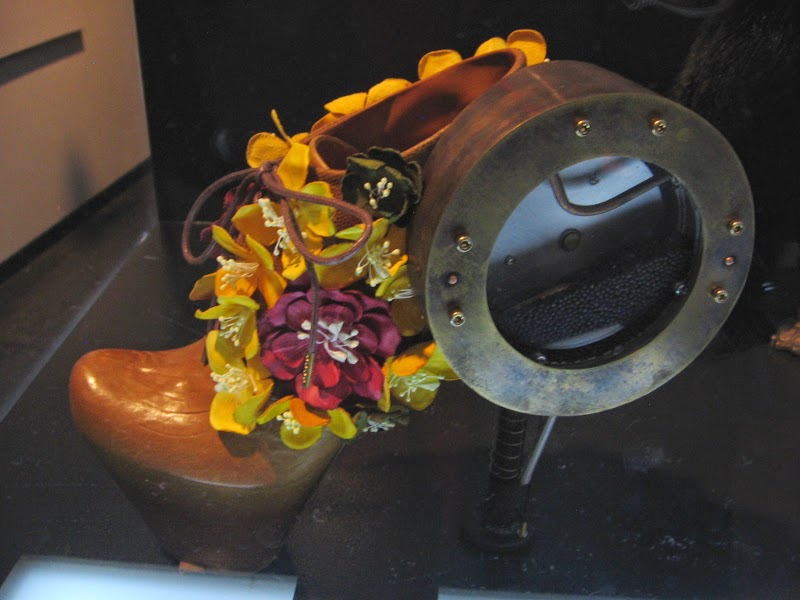
Another exhibit in my collection of art inspired by the Fukushima nuclear disaster is a work titled “Healing Fukushima (Nanohana Heels)", currently displayed as a part of “Killer Heels: The Art of the High-Heeled Shoe” exhibition at the Brooklyn Museum of Art (until March 1, see the video intro on the museum page and my report).
These shoes were co-created in 2012 by an artist and designer
working under the pseudonym Sputniko! (I thought that this was a plucky Yoko-Ono-like
grandma, but it turned out to be a 30-year-old assistant professor at the MIT
Media Lab, Hiromi Ozaki) and a shoe designer Masaya Kushino, a person with the
most Baroque imagination when it comes to creating shoes.
![]() |
| Masaya Kushino. Stairway to Heaven (2013). Heaven? Nah. If I were Hermes, this would be my footwear of choice for trips to Hades. |
The Fukushima shoes are decorated with the flowers of nanohana, a kind
of rapeseed, a plant that absorbs from the soil caesium-137 and strontium-90
and stores them in its stalks, but not its seeds. The idea is that the wearer of
the shoes walks on the ground and the seeds, which are stored in a drum on each shoe, are deposited through the heel into the soil at
every step. The plants grow and absorb the radioactive elements,
and the contamination is cleared. A short movie displayed alongside the shoes
demonstrates how the shoe is supposed to work.
![]() |
| Nanohana Heels in action (movie screenshot) |
What to do about the fact that both caesium
and strontium have 30-year half-life is still unclear, but then who said that art needs to be
practical. In terms of audacity, originality, impracticality, and quixotry, this opus has no serious rivals at this exhibition.
Children's Books at the Grolier Club
The Grolier Club, the oldest active bibliophilic club in the
US, was founded in 1884 by a small group of book lovers headed by Robert Hoe
III, a manufacturer of printing press machinery and an avid book collector, and
was named after Jean Grolier, a statesman, diplomat, and book lover in 16th-century
France.
The club regularly mounts exhibitions on literary and bookmaking topics. The current offerings are One Hundred Books Famous in Children’s Literature (until February 7) displayed in the ground floor hall and Quotations of Chairman Mao (until January 10) in the second floor rare book room (free admission).
![]() |
| Grolier Club entrance. |
Since 1917 the club occupies a small building on East 60th
Street between Madison and Park Avenues, designed by Bertram Grosvenor Goodhue,
who was also the author of the iconic California Tower in Balboa Park in San
Diego. Currently a large-scale construction is going on next door, where a 51-story building is being constructed, using air rights acquired from the Groiler Club and a neighboring church. The facade of No. 47 is also obscured by scaffolding.
![]() |
| One Hundred Books Famous in Children's Literature. Groiler Club, ground floor hall |
The place is charming and the exhibitions are attractive and
well attended. The children’s books exhibit is the sixth in the series of “the Grolier
Hundreds”, after previous exhibitions focused on English literature (1903),
American literature (1946), science (1958), medicine (1994), and fine printed
books (1999). The selection of the “most famous 100” can be debated, but the
most significant works are represented by delectable old editions going as far back
as 17th century. Many of these books come from the Morgan Library and large university libraries. The oldest
book on display appears to be Johann Amos Comenius’ Orbis Sensualium Pictus (Visible World in Pictures), an illustrated
encyclopedia published in London in 1659, an influential early book in children’s
education. Curiously, a number of older books on display are really tiny, as if
made for the children’s small hands rather than for their parents’ and
grandparents’ presbyopic eyes.
A first edition of Charles Perrault's Histoires ou Contes du tempts passe (left) published in 1697 was illustrated with engravings by Antoine Clouzier (from the Princeton University collection). The French edition is open on the first page of Puss in Boots and the English translation lists The Little Red Riding Hood as the very first tale in the table of contents.
Monday, December 22, 2014
Backstage Tour of the Met Opera
![]() |
| Met Opera, main staircase. Photo: Konstantine Sofer |
This past September, I got to visit the American Museum of Natural History after hours and
thoroughly enjoyed the feeling of being where and when I was not supposed to be.
I decided to relive the experience by taking a backstage tour of the Met Opera.
On Sunday morning, about twenty visitors gathered in the Met lobby
and were divided into two groups, each led by a volunteer guide. Our guide was
Hillary, a former dancer and now a theater genie in a Christmas
sweater, bright red eyeglasses, and with her hair dyed a vibrant shade of red.
The tour started with a brief introduction on the main staircase,
after which we proceeded into the auditorium and sat in the front rows to listen to an overview of the Met history. The
auditorium, not yet cleaned after the Saturday night performance,
was permeated with the characteristic and not unpleasant Met smell and looked
like it was resting.
The place is truly enormous. The theater has 3800 seats, placed in a staggered pattern for the best sight lines. The width and spacing between the seats varies, which gives me comfort, because on several occasions I anxiously noted that I was fitting too snugly into my seat. The auditorium is isolated from the outside noise and vibration and has no right angles for optimal acoustics. The walls are covered with African rosewood veneer that came from a single tree, so the entire auditorium responds to sound like a gigantic musical instrument with uniform resonance properties. I recall how during one performance, when I was sitting at the very end of the row, I placed my palm on the wall and felt how the veneer vibrated with the sound from the stage. I found this sensation strangely moving: it felt as though the house was being animated by the music.
Friday, December 19, 2014
How I Chose My First Dance School
When four years ago I decided to start dancing tango and
needed to find the right place to learn, I sampled several dance schools in Chelsea –
NYU area. Triangulo and Dance
Manhattan provided fabulous moments of low comedy, but were not a good fit and were thus rejected. Next on my trial-and-error list was Sandra Cameron Dance Center, which at the time rented space at 440 Lafayette Studios. When I arrived at the 440 Studios for an introductory class, the
first thing I saw after stepping out of the elevator was a large sign written on
the wall: THE ROBERT MOSS THEATER. It was a much bolder and rougher affair than
the sleek, but anemic version installed since then and pictured above. My
fate was sealed. I decided to follow Robert’s skillful way of navigating by coincidences, everyday oracles, and personal symbols, and chose to interpret the writing on the wall as a sign that any place where a Robert Moss runs the show was the place for me. For the next three
years, I reaped generous rewards of this decision.
But "Where are they now?" Dance Manhattan closed in November 2014 (see DM RIP on Robert Bononno’s excellent blog Tango High and Low).
Sandra Cameron closed her studio in the summer of 2013. Triangulo is still alive and kicking. Jeni Breen, who used to lead
the tango program at Sandra’s studio, formed her own Jeni Breen Tango Academy and is still
teaching at 440 Studios, under the newly gentrified glass sign of the Robert
Moss Theater.
Subscribe to:
Posts (Atom)